What did the flight of the urban middle class do to the suburbs? answers.com


A suburban neighborhood in the metropolitan area of Cologne, Germany
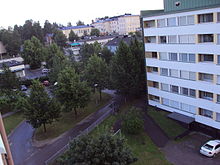

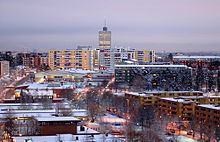
A suburb (suburban or suburban area) is an area outside of a principal city of a metropolitan expanse, which may include commercial and mixed-use, but is primarily a residential surface area.[1] [2] A suburb tin be either every bit part of a larger metropolis/urban area or as a separate political entity. The proper noun describes an expanse which is not as densely populated as an inner city, yet more than densely populated than a rural area in the countryside. In many metropolitan areas, suburbs exist as separate residential communities inside commuting distance of a urban center (cf "sleeping accommodation suburb".) Suburbs can accept their own political or legal jurisdiction, particularly in the The states, but this is not always the case, especially in the United Kingdom, where about suburbs are located inside the administrative boundaries of cities.[iii] In most English-speaking countries, suburban areas are defined in contrast to primal or inner city areas, but in Australian English and South African English language, suburb has become largely synonymous with what is called a "neighborhood" in other countries, and the term encompasses inner city areas.[ citation needed ]
In some areas, such as Australia, Republic of india, China, New Zealand, Canada, the United kingdom of great britain and northern ireland, and parts of the U.s., new suburbs are routinely annexed by side by side cities due to urban sprawl. In others, such equally Morocco, French republic, and much of the U.s., many suburbs remain separate municipalities or are governed locally every bit part of a larger metropolitan area such as a county, district or borough. In the United States, regions beyond the suburbs are known as "exurban areas" or exurbs; exurbs accept less population density than suburbs, merely still more than rural areas. Suburbs and exurbs are linked to the nearby larger metropolitan area economically, specially by commuters.
Suburbs first emerged on a big calibration in the 19th and 20th centuries as a result of improved rail and road send, which led to an increase in commuting.[4] In general, they are less densely populated than inner metropolis neighborhoods inside the same metropolitan expanse, and most residents routinely commute to city centers or business organisation districts via private vehicles or public transits; nonetheless, there are many exceptions, including industrial suburbs, planned communities and satellite cities. Suburbs tend to proliferate around cities that accept an abundance of adjacent flat land.[v]
In the United states, suburbs typically have the connotation of being more affluent, educated, and middle-class than city neighborhoods. Suburbs are often culturally distinct from the cities they orbit. The term "suburbia" is a mocking or slightly pejorative word for the mass civilization of suburbs, calling to mind endless acres of single-family homes surrounded past carefully-mown lawns, with a civilization that prizes heart-grade conformity and frowns on differences and diversity.
Etymology and usage [edit]
The English give-and-take is derived from the Old French subburbe , which is in turn derived from the Latin suburbium , formed from sub (meaning "nether" or "beneath") and urbs ("urban center"). The showtime recorded usage of the term in English, was by John Wycliffe in 1380, when the form subarbis was used, according to the Oxford English Dictionary.
In Commonwealth of australia, New Zealand and South Africa [edit]

In Australia, New Zealand and South Africa, suburban areas (in the wider sense noted in the lead paragraph) have become formalised equally geographic subdivisions of a city and are used by postal services in addressing. In rural areas in both countries, their equivalents are chosen localities (see suburbs and localities). The terms inner suburb and outer suburb are used to differentiate between the higher-density areas in proximity to the city heart (which would not be referred to as 'suburbs' in most other countries), and the lower-density suburbs on the outskirts of the urban area. The term 'heart suburbs' is too used. Inner suburbs, such equally Te Aro in Wellington, Eden Terrace in Auckland, Prahran in Melbourne and Ultimo in Sydney, are commonly characterised past higher density apartment housing and greater integration betwixt commercial and residential areas.
In New Zealand, virtually suburbs are non legally divers, which can lead to confusion equally to where they may brainstorm and stop.[6] A geospatial dataset defining suburbs for use past emergency services is developed and maintained past Burn and Emergency New Zealand and is published[vii] under an open license.
In the Uk and Ireland [edit]

In the United Kingdom and Ireland, the term suburb simply refers to a residential surface area outside the city centre, regardless of authoritative boundaries.[four] Suburbs, in this sense, can range from areas that seem more than like residential areas of a urban center proper to areas separated by open countryside from the metropolis centre. In large cities such as London and Leeds, many suburbs are formerly separate towns and villages that accept been captivated during a city'south expansion, such as Ealing, Bromley, and Guiseley. In Ireland, this tin can exist seen in the Dublin suburban areas of Swords, Blanchardstown, and Tallaght.
In North America [edit]
In the United States and Canada, suburb can refer either to an outlying residential area of a city or town or to a split up municipality or unincorporated expanse outside a boondocks or urban center.[ citation needed ]
Although a majority of Americans regard themselves as residents of suburban communities, the federal regime of the United States has no formal definition for what constitutes a suburb in the United states, leaving its precise significant disputed.[8] [9]
In Canada, the term may also exist used in the British sense, specially as cities addendum formerly outlying areas.[ citation needed ]
History [edit]
The history of suburbia is role of the study of urban history, which focuses on the origins, growth, diverse typologies, culture, and politics of suburbs, also as on the gendered and family unit-oriented nature of suburban infinite.[10] [11] Many people have assumed that early on-20th-century suburbs were enclaves for middle-class whites, a concept that carries tremendous cultural influence yet is actually stereotypical. Some suburbs are based on a society of working-form and minority residents, many of whom want to own their own house. Meanwhile, other suburbs accept instituted "explicitly racist" policies to deter people deemed as "other", a practise most mutual in the United States in dissimilarity to other countries around the world.[12] Mary Corbin Sies argues that it is necessary to examine how "suburb" is defined as well equally the stardom made between cities and suburbs, geography, economic circumstances, and the interaction of numerous factors that move research beyond acceptance of stereotyping and its influence on scholarly assumptions.[thirteen]
Early history [edit]
The earliest advent of suburbs coincided with the spread of the kickoff urban settlements. Big walled towns tended to be the focus around which smaller villages grew up in a symbiotic relationship with the market town. The word suburbani was first employed by the Roman statesman Cicero in reference to the large villas and estates congenital by the wealthy patricians of Rome on the city'due south outskirts.
Towards the end of the Eastern Han Dynasty (until 190 Advertising, when Dong Zhuo razed the city) the upper-case letter, Luoyang, was mainly occupied by the emperor and important officials; the city's people mostly lived in small cities correct exterior Luoyang, which were suburbs in all but proper name.[14]
As populations grew during the Early on Modern Period in Europe, towns swelled with a steady influx of people from the countryside. In some places, nearby settlements were swallowed up as the main city expanded. The peripheral areas on the outskirts of the metropolis were by and large inhabited by the very poorest.[15]
Origins of the modernistic suburb [edit]
Due to the rapid migration of the rural poor to the industrializing cities of England in the belatedly 18th century, a trend in the opposite management began to develop, whereby newly rich members of the middle classes began to buy estates and villas on the outskirts of London. This trend accelerated through the 19th century, specially in cities like London and Birmingham that were growing quickly, and the first suburban districts sprung up effectually the city centres to accommodate those who wanted to escape the squalid weather of the industrial towns. Initially, such growth came along rail lines in the form of ribbon developments, every bit suburban residents could commute via railroad train into the metropolis center for work. In Australia, where Melbourne would presently become the second-largest urban center in the British Empire,[sixteen] the distinctively Australasian suburb, with its loosely aggregated quarter-acre sections, adult in the 1850s[17] and eventually became a component of the Australian Dream.
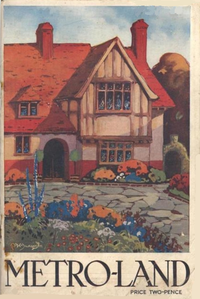
The cover of the Metro-Land guide published in 1921
Toward the cease of the century, with the development of public transit systems such as the undercover railways, trams and buses, it became possible for the majority of a urban center's population to reside outside the city and to commute into the center for work.[15]
By the mid-19th century, the first major suburban areas were springing up around London equally the urban center (so the largest in the world) became more overcrowded and unsanitary. A major catalyst for suburban growth was the opening of the Metropolitan Railway in the 1860s. The line after joined the capital'due south fiscal heart in the City to what were to get the suburbs of Middlesex.[18] The line reached Harrow in 1880.
Unlike other railway companies, which were required to dispose of surplus land, London'southward Met was immune to retain such state that information technology believed was necessary for future railway utilise.[note 1] Initially, the surplus state was managed by the State Committee,[twenty] and, from the 1880s, the land was developed and sold to domestic buyers in places like Willesden Park Estate, Cecil Park, nigh Pinner and at Wembley Park.
In 1912 it was suggested[ by whom? ] that a especially formed visitor should take over from the Surplus Lands Committee and develop suburban estates about the railway.[21] Even so, World War I (1914–1918) delayed these plans until 1919, when, with the expectation of a postwar housing-smash,[22] Metropolitan Railway Country Estates Limited (MRCE) formed. MRCE went on to develop estates at Kingsbury Garden Village near Neasden, Wembley Park, Cecil Park and Grange Estate at Pinner and the Cedars Manor at Rickmansworth and to constitute places such equally Harrow Garden Hamlet.[22] [23]
The Met'south marketing section coined the term "Metro-country" in 1915 when the Guide to the Extension Line became the Metro-land guide, priced at 1d. This promoted the land served by the Met for the walker, visitor and later the house-hunter.[21] Published annually until 1932 (the concluding full year of independence for the Met), the guide extolled the benefits of "The adept air of the Chilterns", using language such every bit "Each lover of Metroland may well have his own favourite woods beech and coppice — all tremulous green loveliness in Bound and russet and gold in October".[24] The dream as promoted involved a modern habitation in beautiful countryside with a fast railway-service to central London.[25] By 1915 people from beyond London had flocked to live the new suburban dream in big newly built areas across north-w London.[26]
Interwar suburban expansion in England [edit]
Suburbanisation in the interwar period was heavily influenced past the garden city movement of Ebenezer Howard and the creation of the first garden suburbs at the plow of the 20th century.[27] The first garden suburb was adult through the efforts of social reformer Henrietta Barnett and her hubby; inspired past Ebenezer Howard and the model housing development movement (then exemplified past Letchworth garden urban center), too as the desire to protect office of Hampstead Heath from development, they established trusts in 1904 which bought 243 acres of land along the newly opened Northern line extension to Golders Dark-green and created the Hampstead Garden Suburb. The suburb attracted the talents of architects including Raymond Unwin and Sir Edwin Lutyens, and it ultimately grew to encompass over 800 acres.[28]
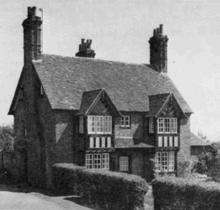
During the Commencement World War the Tudor Walters Committee was deputed to brand recommendations for the post state of war reconstruction and housebuilding. In part, this was a response to the shocking lack of fettle amid many recruits during World State of war One, attributed to poor living conditions; a belief summed up in a housing affiche of the flow "you cannot look to get an A1 population out of C3 homes" – referring to military fettle classifications of the menses.
The committee'due south study of 1917 was taken upwards by the government, which passed the Housing, Town Planning, &c. Act 1919, also known as the Addison Deed after Dr. Christopher Addison, the and so Minister for Housing. The Act immune for the building of large new housing estates in the suburbs after the First World War,[29] and marked the showtime of a long 20th century tradition of state-owned housing, which would later evolve into council estates.
The Report as well legislated on the required, minimum standards necessary for farther suburban construction; this included regulation on the maximum housing density and their arrangement and information technology fifty-fifty fabricated recommendations on the ideal number of bedrooms and other rooms per house. Although the semi-detached house was first designed by the Shaws (a begetter and son architectural partnership) in the 19th century, it was during the suburban housing boom of the interwar menses that the design showtime proliferated as a suburban icon, existence preferred by middle-grade habitation owners to the smaller terraced houses.[30] The design of many of these houses, highly characteristic of the era, was heavily influenced by the Art Deco movement, taking influence from Tudor Revival, chalet mode, and even ship blueprint.
Within just a decade suburbs dramatically increased in size. Harrow Backwoods went from just 1,500 to over 10,000 while Pinner jumped from 3,000 to over 20,000. During the 1930s, over 4 million new suburban houses were congenital, the 'suburban revolution' had made England the well-nigh heavily suburbanized land in the world, by a considerable margin.[4]
Bangladesh [edit]
People's republic of bangladesh has multiple suburbs, Uttara & Ashulia to name a few. Yet, most suburbs in Dhaka are different than the ones in Europe & Americas. Most suburbs in Bangladesh are filled with loftier rise buildings, paddy fields, and farms, and are designed more like rural villages.
North America [edit]
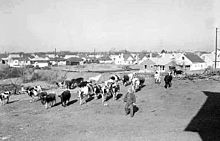
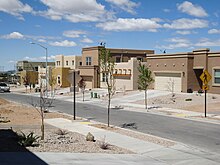

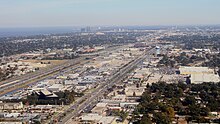
Suburban Dallas, Texas, seen in the foreground
Boston and New York spawned the start major suburbs. The streetcar lines in Boston and the rail lines in Manhattan made daily commutes possible.[31] No metropolitan expanse in the globe was also served by railroad commuter lines at the turn of the twentieth century every bit New York, and it was the rail lines to Westchester from the Thousand Central Final commuter hub that enabled its development. Westchester's true importance in the history of American suburbanization derives from the upper-centre form evolution of villages including Scarsdale, New Rochelle and Rye serving thousands of businessmen and executives from Manhattan.[32]
Mail service-war suburban expansion [edit]
The suburban population in Northward America exploded during the post-World War Ii economic expansion. Returning veterans wishing to get-go a settled life moved in masses to the suburbs. Levittown adult every bit a major paradigm of mass-produced housing. Due to the influx of people in these suburban areas, the corporeality of shopping centers began to increment equally suburban America took shape. These malls helped supply goods and services to the growing urban population. Shopping for dissimilar appurtenances and services in one key location without having to travel to multiple locations, helped to keep shopping centers a component of these newly designed suburbs which were booming in population. The television helped contribute to the rise of shopping centers due to the increased advertising on television in addition to a desire to have products shown in suburban life in various tv set programs. Another cistron that led to the rise of these shopping centers was the building of many highways. The Highway Human action of 1956 helped to fund the building of 64,000 kilometers across the nation past having $26 thousand-million to employ, which helped to link many more to these shopping centers with ease.[33] These newly built shopping centers, which were often large buildings full of multiple stores, and services, were beingness used for more than than shopping, merely every bit a identify of leisure and a meeting point for those who lived within suburban America at this time. These centers thrived offering goods and services to the growing populations in suburban America. In 1957, 940 Shopping centers were built and this number more than doubled by 1960 to proceed up with the demand of these densely populated areas.[34]
Housing [edit]


Very picayune housing had been built during the Great Low and World War II, except for emergency quarters almost state of war industries. Overcrowded and inadequate apartments was the mutual condition. Some suburbs had developed effectually big cities where at that place was rail transportation to the jobs downtown. However, the real growth in suburbia depended on the availability of automobiles, highways, and inexpensive housing. The population had grown, and the stock of family unit savings had accumulated the coin for downwardly payments, automobiles and appliances. The product was a bully housing blast. Whereas, an average of 316,000 new housing non-farm units should take been constructed 1930s through 1945, at that place were ane,450,000 annually from 1946 through 1955.[35] The G.I. Bill guaranteed low cost loans for veterans, with very low down payments, and low interest rates. With 16 1000000 eligible veterans, the opportunity to purchase a firm was suddenly at paw. In 1947 alone, 540,000 veterans bought one; their average price was $7300. The construction industry kept prices low by standardization – for example standardizing sizes for kitchen cabinets, refrigerators and stoves, allowed for mass production of kitchen furnishings. Developers purchased empty land simply outside the metropolis, installed tract houses based on a handful of designs, and provided streets and utilities, or local public officials race to build schools.[36] The about famous development was Levittown, in Long Island just e of New York Metropolis. Information technology offered a new house for $grand downwardly, and $70 a month; information technology featured iii bedrooms, fireplace, gas range and gas furnace, and a landscaped lot of 75 by 100 feet, all for a total price of $10,000. Veterans could get 1 with a much lower down payment.[37]
At the aforementioned time, African Americans were rapidly moving north and west for improve jobs and educational opportunities than were available to them in the segregated Southward. Their inflow in Northern and Western cities en masse, in addition to being followed by race riots in several large cities such as Philadelphia, Los Angeles, Detroit, Chicago, and Washington, D.C., further stimulated white suburban migration. The growth of the suburbs was facilitated by the development of zoning laws, redlining and numerous innovations in transport. The policy of redlining and other discriminatory measures congenital into federal housing policy furthered the racial segregation of postwar America for example past refusing to insure mortgages in and near African-American neighborhoods. The authorities's efforts were primarily designed to provide housing to white, eye-class or lower-middle-grade families. African-Americans and other people of color largely remained full-bodied within decaying cores of urban poverty creating a phenomenon known as white flight.[38]
After World War 2, availability of FHA loans stimulated a housing boom in American suburbs. In the older cities of the northeast U.S., streetcar suburbs originally developed forth train or trolley lines that could shuttle workers into and out of city centers where the jobs were located. This practise gave rise to the term "bedroom community", meaning that well-nigh daytime business activity took place in the urban center, with the working population leaving the city at night for the purpose of going home to sleep.
Economic growth in the Usa encouraged the suburbanization of American cities that required massive investments for the new infrastructure and homes. Consumer patterns were also shifting at this time, as purchasing ability was becoming stronger and more attainable to a wider range of families. Suburban houses also brought about needs for products that were non needed in urban neighborhoods, such every bit lawnmowers and automobiles. During this time commercial shopping malls were being developed near suburbs to satisfy consumers' needs and their car–dependent lifestyle.[39]
Zoning laws also contributed to the location of residential areas exterior of the urban center center by creating wide areas or "zones" where just residential buildings were permitted. These suburban residences are built on larger lots of land than in the central city. For example, the lot size for a residence in Chicago is usually 125 anxiety (38 chiliad) deep,[40] while the width can vary from 14 feet (iv.3 m) wide for a row house to 45 feet (14 m) wide for a large stand–alone house.[ commendation needed ] In the suburbs, where stand up–alone houses are the rule, lots may exist 85 feet (26 yard) wide by 115 feet (35 m) deep, as in the Chicago suburb of Naperville.[ commendation needed ] Manufacturing and commercial buildings were segregated in other areas of the metropolis.
Alongside suburbanization, many companies began locating their offices and other facilities in the outer areas of the cities, which resulted in the increased density of older suburbs and the growth of lower density suburbs even further from urban center centers. An alternative strategy is the deliberate pattern of "new towns" and the protection of green belts around cities. Some social reformers attempted to combine the best of both concepts in the garden urban center movement.[41]
In the U.S., 1950 was the first year that more people lived in suburbs than elsewhere.[42] In the U.S, the development of the skyscraper and the sharp inflation of downtown existent estate prices too led to downtowns being more fully dedicated to businesses, thus pushing residents exterior the metropolis middle.
Australia and New Zealand [edit]
![[icon]](https://upload.wikimedia.org/wikipedia/commons/thumb/1/1c/Wiki_letter_w_cropped.svg/20px-Wiki_letter_w_cropped.svg.png) | This section needs expansion. Y'all can help by calculation to it. (August 2021) |
Worldwide [edit]

In many parts of the adult world, suburbs tin can be economically distressed areas, inhabited by higher proportions of recent immigrants, with higher delinquency rates and social problems. Sometimes the notion of suburb may even refer to people in real misery, who are kept at the limit of the city borders for economic, social, and sometimes ethnic reasons. An example in the developed earth would be the banlieues of France, or the concrete suburbs of Sweden, fifty-fifty if the suburbs of these countries also include eye-grade and upper-class neighbourhoods that frequently consist of single-family unit houses. Some of the suburbs in most of the adult world are comparable to several inner cities of the U.S.
Africa [edit]
Following the growth of the middle class due to the industrialization of many African countries, the development of eye-class suburbs has boomed since the beginning of the 1990s, particularly in cities such as Cairo, Nairobi, Johannesburg, and Lagos.
In an illustrative example of S Africa, RDP housing has been built. In much of Soweto, many houses are American in appearance, but are smaller, and often consist of a kitchen and living room, two or three bedrooms, and a bathroom. All the same, in that location are more affluent neighborhoods, more comparable to American suburbs, particularly e of the FNB Stadium and southward of the city in areas like Eikenhof, where the "Middle of Africa" planned community exists.[43] This chief-planned community is nearly duplicate from the most assiduities-rich resort-style American suburbs in Florida, Arizona, and California, consummate with a golf course, resort pool, equestrian middle, 24-hour manned gates, gym, and BMX track, besides every bit several tennis, basketball, and volleyball courts.[44]
In Cape Town, in that location is a distinct European style which is due to the European influence during the mid-1600s when the Dutch settled the Cape. Houses similar these are called Cape Dutch Houses and tin be plant in the flush suburbs of Constantia and Bishopscourt.
Commonwealth of australia [edit]
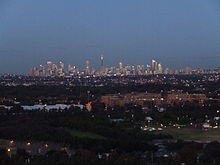
The Australian usage came almost equally outer areas were quickly surrounded in fast-growing cities, but retained the appellation suburb; the term was somewhen applied to the original core likewise. In Australia, Sydney'due south urban sprawl has occurred predominantly in the Western Suburbs. The locality of Olympic Park was designated an official suburb in 2009.[45]
Canada [edit]

Canadian suburbs oftentimes feature high density nodes, equally seen in Burnaby, British Columbia.
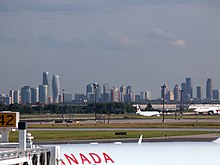
Canada is an urbanized nation where over 80% of the population live in urban areas (loosely defined), and roughly two-thirds alive in one of Canada's 33 census metropolitan areas (CMAs) with a population of over 100,000. Yet, of this metropolitan population, in 2001 nearly one-half lived in depression-density neighborhoods, with only i in five living in a typical "urban" neighborhood. The percentage living in depression-density neighborhoods varied from a high of well-nigh two-thirds of Calgary CMA residents (67%), to a depression of nigh one-third of Montréal CMA residents (34%).
Often, Canadian suburbs are less automobile-centred and public transit utilize is encouraged just can exist notably unused.[46] Throughout Canada, there are comprehensive plans in place to curb sprawl.
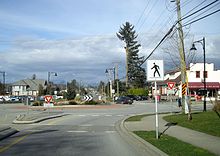
Population and income growth in Canadian suburbs had tended to outpace growth in cadre urban or rural areas, but in many areas this tendency has at present reversed. The suburban population increased 87% betwixt 1981 and 2001, well ahead of urban growth.[47] The majority of recent population growth in Canada'due south iii largest metropolitan areas (Greater Toronto, Greater Montréal, and Greater Vancouver) has occurred in non-core municipalities. This trend is besides beginning to have effect in Vancouver, and to a lesser extent, Montréal. In certain cities, particularly Edmonton and Calgary, suburban growth takes place within the city boundaries as opposed to in bedroom communities. This is due to annexation and big geographic footprint within the city borders.
Calgary is unusual amongst Canadian cities because information technology has developed as a unicity – information technology has annexed most of its surrounding towns and large amounts of undeveloped country effectually the city. Every bit a event, most of the communities that Calgarians refer to equally "suburbs" are really inside the city limits.[48] In the 2016 demography, the City of Calgary had a population of 1,239,220, whereas the Calgary Metropolitan Expanse had a population of 1,392,609, indicating the vast bulk of people in the Calgary CMA lived within the city limits. The perceived low population density of Calgary largely results from its many internal suburbs and the large amount of undeveloped country within the city. The metropolis actually has a policy of densifying its new developments.[49]
Prc [edit]

Apartments in suburban Beijing, Mainland china
In Communist china, the term suburb is new, although suburbs are already existence constructed rapidly. Chinese suburbs mostly consist of rows upon rows of apartment blocks and condos that terminate abruptly into the countryside.[fifty] [51] Also new town developments are extremely mutual. Unmarried family suburban homes tend to be similar to their Western equivalents; although primarily outside Beijing and Shanghai, also mimic Spanish and Italian architecture.[52]
Hong Kong [edit]
In Hong Kong, however, suburbs are generally government-planned new towns containing numerous public housing estates. New Towns such equally Tin Shui Wai may proceeds notoriety as a slum. However, other new towns also contain private housing estates and low density developments for the upper classes.
Italy [edit]
In the illustrative case of Rome, Italy, in the 1920s and 1930s, suburbs were intentionally created ex novo to give lower classes a destination, in consideration of the actual and foreseen massive inflow of poor people from other areas of the country. Many critics have seen in this evolution pattern (which was circularly distributed in every management) also a quick solution to a problem of public order (keeping the unwelcome poorest classes together with the criminals, in this way improve controlled, comfortably remote from the elegant "official" town). On the other hand, the expected huge expansion of the boondocks soon finer covered the distance from the central town, and now those suburbs are completely engulfed by the master territory of the town. Other newer suburbs (called exurbs) were created at a farther altitude from them.[ citation needed ]
Nippon [edit]
In Japan, the construction of suburbs has boomed since the terminate of World War II and many cities are experiencing the urban sprawl outcome.
Latin America [edit]
In Mexico, suburbs are generally similar to their United States counterparts. Houses are made in many different architectural styles which may exist of European, American and International architecture and which vary in size. Suburbs can be establish in Guadalajara, Mexico Metropolis, Monterrey, and most major cities. Lomas de Chapultepec is an case of an affluent suburb, although it is located inside the metropolis and by no means is today a suburb in the strict sense of the word. In other countries, the situation is like to that of Mexico, with many suburbs existence built, most notably in Peru and Chile, which take experienced a boom in the construction of suburbs since the late 1970s and early 80s. Equally the growth of eye-course and upper-class suburbs increased, low-grade squatter areas have increased, almost notably "lost cities" in United mexican states, campamentos in Chile, barriadas in Republic of peru, villa miserias in Argentina, asentamientos in Republic of guatemala and favelas of Brazil.
Brazilian flush suburbs are generally denser, more than vertical and mixed in use inner suburbs. They concentrate infrastructure, investment and attending from the municipal seat and the best offer of mass transit. True sprawling towards neighboring municipalities is typically empoverished – periferia (the periphery, in the sense of it dealing with spatial marginalization) –, with a very noticeable instance being the rail suburbs of Rio de Janeiro – the North Zone, the Baixada Fluminense, the function of the West Zone associated with SuperVia's Ramal de Santa Cruz. These, in comparison with the inner suburbs, often prove to be remote, violent food deserts with inadequate sewer structure coverage, saturated mass transit, more precarious running h2o, electricity and advice services, and lack of urban planning and landscaping, while also not necessarily qualifying as actual favelas or slums. They oftentimes are one-time agricultural state or wild areas settled through squatting; suburbs grew and expanded due to the mass rural exodus during the years of the military dictatorship. This is particularly true of São Paulo, Rio de Janeiro and Brasília, which grew with migration from more distant and impoverished parts of the country and deal with overpopulation as a result.
Malaysia [edit]

In Malaysia, suburbs are common, especially in areas surrounding the Klang Valley, which is the largest conurbation in the country.[ commendation needed ] These suburbs also serve as major housing areas and commuter towns. Terraced houses, Semi-detached houses and shophouses are mutual concepts in suburbs. In certain areas such as Klang, Subang Jaya and Petaling Jaya, suburbs form the core of these places. The latter 1 has been turned into a satellite city of Kuala Lumpur. Suburbs are also evident in other major conurbations in the country including Penang (e.thou. Pulau Tikus), Ipoh (east.g. Bercham), Johor Bahru (due east.grand. Tebrau), Kota Kinabalu (eastward.g. Likas), Kuching (due east.g. Stampin), Melaka City (e.g. Batu Berendam) and Alor Setar (eastward.yard. Anak Bukit).
Russia [edit]
In Russia, until recently, the term suburb refers to loftier-rise residential apartments which unremarkably consist of two bedrooms, 1 bathroom, a kitchen and a living room. Nevertheless, since the beginning of the 21st century in Russian federation at that place has been a "cottage boom", as a result of which a huge number of cottage villages appeared in virtually every metropolis of the land (including Moscow), no different from the suburbs in western countries.[ commendation needed ]
United Kingdom [edit]
In the United kingdom suburbs are located between the exurbs and city centres of a metropolitan area. The growth in the utilize of trains, and afterward automobiles and highways, increased the ease with which workers could have a job in the metropolis while commuting in from the suburbs. In the United Kingdom, as mentioned higher up, railways stimulated the start mass exodus to the suburbs. The Metropolitan Railway, for example, was active in edifice and promoting its ain housing estates in the north-west of London, consisting mostly of detached houses on large plots, which it and so marketed as "Metro-land".[53] In the United kingdom of great britain and northern ireland, the government is seeking to impose minimum densities on newly approved housing schemes in parts of Due south East England. The goal is to "build sustainable communities" rather than housing estates. Withal, commercial concerns tend to delay the opening of services until a large number of residents have occupied the new neighbourhood.
Usa [edit]
In the 20th century, many suburban areas, especially those not within the political boundaries of the city containing the key business concern expanse, began to meet independence from the key city as an asset. In some cases, suburbanites saw self-regime every bit a means to keep out people who could not afford the added suburban belongings maintenance costs not needed in metropolis living. Federal subsidies for suburban development accelerated this process as did the exercise of redlining by banks and other lending institutions.[54] In some cities such as Miami and San Francisco, the master metropolis is much smaller than the surrounding suburban areas, leaving the city proper with a small portion of the metro area's population and land area.
Mesa, Arizona, and Virginia Beach, Virginia, the two most populous suburbs in the U.s., are actually more populous than many core cities, including Miami, Minneapolis, New Orleans, Cleveland, Tampa, St. Louis, Pittsburgh, Cincinnati, and others. Virginia Beach is now the largest city in all of Virginia, having long since exceeded the population of its neighboring primary urban center, Norfolk. While Virginia Beach has slowly been taking on the characteristics of an urban city, it will non probable achieve the population density and urban characteristics of Norfolk. It is mostly assumed that the population of Chesapeake, another Hampton Roads city, will also exceed that of Norfolk in 2018 if its current growth rate continues at its aforementioned pace.
Cleveland, Ohio, is typical of many American central cities; its municipal borders have changed little since 1922, even though the Cleveland urbanized expanse has grown many times over.[ citation needed ] Several layers of suburban municipalities now surround cities similar Boston, Cleveland, Chicago, Detroit, Los Angeles, Dallas, Denver, Houston, New York City, San Francisco, Sacramento, Atlanta, Miami, Baltimore, Milwaukee, Pittsburgh, Philadelphia, Phoenix, Roanoke, St. Louis, Table salt Lake Metropolis, Las Vegas, Minneapolis, and Washington, D.C..
Suburbs in the Usa take a prevalence of usually detached[55] single-family homes.[56]
They are characterized by:
- Lower densities than central cities, dominated by unmarried-family homes on small-scale plots of land – anywhere from 0.ane acres[10] and upwards – surrounded at close quarters by very similar dwellings.
- Zoning patterns that divide residential and commercial evolution, besides as dissimilar intensities and densities of development. Daily needs are non inside walking distance of most homes.
- A greater percent of whites (both not-Hispanic and, in some areas, Hispanic) and bottom percentage of citizens of other ethnic groups than in urban areas. However, black suburbanization grew betwixt 1970 and 1980 by 2.half-dozen% as a result of central city neighborhoods expanding into older neighborhoods vacated by whites.[57] [58] [59]
- Subdivisions carved from previously rural land into multiple-dwelling house developments built by a unmarried real estate company. These subdivisions are often segregated by infinitesimal differences in home value, creating unabridged communities where family incomes and demographics are virtually completely homogeneous.[ commendation needed ].
- Shopping malls and strip malls behind large parking lots instead of a archetype downtown shopping district.
- A road network designed to conform to a bureaucracy, including culs-de-sac, leading to larger residential streets, in plow leading to big collector roads, in place of the grid blueprint common to well-nigh central cities and pre-Globe State of war II suburbs.
- A greater pct of ane-story administrative buildings than in urban areas.
- Compared to rural areas, suburbs unremarkably have greater population density, higher standards of living, more complex road systems, more franchised stores and restaurants, and less farmland and wild fauna.
Past 2010, suburbs increasingly gained people in racial minority groups, as many members of minority groups gained better access to education and sought more than favorable living weather condition compared to inner metropolis areas.
Conversely, many white Americans also moved back to city centers. Nearly all major urban center downtowns (such as Downtown Miami, Downtown Detroit, Downtown Philadelphia, Downtown Roanoke, or Downtown Los Angeles) are experiencing a renewal, with large population growth, residential flat construction, and increased social, cultural, and infrastructural investments, every bit have suburban neighborhoods close to urban center centers. Better public transit, proximity to piece of work and cultural attractions, and frustration with suburban life and gridlock accept attracted young Americans to the city centers.[sixty]
Traffic flows [edit]
Suburbs typically have longer travel times to work than traditional neighborhoods.[61] Only the traffic inside the brusque streets themselves is less. This is due to three factors:[ citation needed ] almost-mandatory motorcar ownership due to poor suburban bus systems, longer travel distances and the hierarchy arrangement, which is less efficient at distributing traffic than the traditional grid of streets.
In the suburban system, most trips from one component to another component requires that cars enter a collector road[ commendation needed ], no matter how short or long the distance is. This is compounded by the hierarchy of streets, where entire neighborhoods and subdivisions are dependent on one or 2 collector roads. Because all traffic is forced onto these roads, they are ofttimes heavy with traffic all day. If a traffic crash occurs on a collector road, or if road structure inhibits the flow, then the unabridged road organization may exist rendered useless until the blockage is cleared. The traditional "grown" grid, in turn, allows for a larger number of choices and alternate routes.
Suburban systems of the sprawl type are also quite inefficient for cyclists or pedestrians, as the direct route is usually non available for them either[ commendation needed ]. This encourages car trips even for distances as low as several hundreds of yards or meters (which may take become up to several miles or kilometers due to the road network). Improved sprawl systems, though retaining the motorcar detours, possess cycle paths and footpaths connecting across the arms of the sprawl organisation, allowing a more direct route while still keeping the cars out of the residential and side streets.
More commonly, cardinal cities seek ways to tax nonresidents working downtown – known as driver taxes – as property taxation bases dwindle. Taken together, these 2 groups of taxpayers represent a largely untapped source of potential revenue that cities may begin to target more aggressively, specially if they're struggling. According to struggling cities, this will help bring in a substantial acquirement for the city which is a keen fashion to tax the people who make the virtually utilise of the highways and repairs.
Today more companies settle downward in suburbs because of depression property costs.
Criticism [edit]
In pop culture [edit]
Suburbs and suburban living have been the subject for a wide diverseness of films, books, goggle box shows and songs.
French songs like La Zone by Fréhel (1933), Aux quatre coins de la banlieue by Damia (1936), Ma banlieue past Reda Caire (1937), or Banlieue by Robert Lamoureux (1953), evoke the suburbs of Paris explicitly since the 1930s.[63] Those singers give a sunny festive, well-nigh bucolic, prototype of the suburbs, yet still few urbanized. During the fifties and the sixties, French singer-songwriter Léo Ferré evokes in his songs popular and proletarian suburbs of Paris, to oppose them to the city, considered by comparing equally a bourgeois and conservative identify.
French cinema was although soon interested in urban changes in the suburbs, with such movies as Monday oncle past Jacques Tati (1958), L'Amour existe by Maurice Pialat (1961) or Two or Iii Things I Know Well-nigh Her by Jean-Luc Godard (1967).
In his ane-act opera Problem in Tahiti (1952), Leonard Bernstein skewers American suburbia, which produces misery instead of happiness.
The American photojournalist Bill Owens documented the culture of suburbia in the 1970s, most notably in his volume Bourgeoisie. The 1962 vocal "Piddling Boxes" by Malvina Reynolds lampoons the development of suburbia and its perceived bourgeois and conformist values,[64] while the 1982 vocal Subdivisions by the Canadian ring Rush also discusses suburbia, as does Rockin' the Suburbs by Ben Folds. The 2010 album The Suburbs past the Canadian-based alternative band Arcade Fire dealt with aspects of growing upwardly in bourgeoisie, suggesting aimlessness, apathy and endless rushing are ingrained into the suburban culture and mentality. Suburb The Musical, was written by Robert Southward. Cohen and David Javerbaum. Over the Hedge is a syndicated comic strip written and drawn past Michael Fry and T. Lewis. It tells the story of a raccoon, turtle, a squirrel, and their friends who come up to terms with their woodlands beingness taken over by suburbia, trying to survive the increasing flow of humanity and technology while condign enticed by it at the aforementioned time. A film adaptation of Over the Hedge was produced in 2006.
British television series such as The Good Life, Butterflies and The Autumn and Rise of Reginald Perrin have depicted suburbia as well-manicured only relentlessly boring, and its residents as either overly conforming or prone to going stir crazy. In contrast, U.S. shows such equally Knots Landing, Desperate Housewives and Weeds portray the suburbs every bit concealing darker secrets backside a façade of manicured lawns, friendly people, and beautifully kept houses. Films such equally The 'Burbs and Disturbia have brought this theme to the cinema.
See also [edit]
- Exurb
- Bibliography of suburbs
- Criticism of suburbia
- Boomburbs
- Ethnoburb
- Faubourg
- Microdistrict
- Adult environments
- Settlement types
- Rural–urban fringe
- Slum
- Subdivision
- List of satellite cities past population
Notes [edit]
- ^ The Land Clauses Consolidation Act 1845 required railways to sell off surplus lands within ten years of the time given for completion of the work in the line's enabling Deed.[xix]
References [edit]
- ^ "Strip Mall Plans".
- ^ "Types of Zoning".
- ^ Caves, R. Westward. (2004). Encyclopedia of the City. Routledge. p. 640. ISBN9780415252256.
- ^ a b c Hollow, Matthew (2011). "Suburban Ideals on England's Interwar Council Estates". Journal of the Garden History Lodge . Retrieved 29 December 2012.
- ^ The Fractured Metropolis: Improving the New City, Restoring the Old Urban center, Reshaping the Region by Jonathan Barnett, via Google Books.
- ^ "Suburb boundaries – a Official Information Deed request to Christchurch Metropolis Quango". FYI. thirty March 2018. Archived from the original on 20 April 2018. Retrieved twenty Apr 2018.
- ^ "Burn down and Emergency NZ Localities - Burn down and Emergency NZ | | GIS Data Map Mapping | LINZ Information Service". data.linz.govt.nz . Retrieved 21 September 2021.
- ^ "How to Tell If You Alive in the Suburbs".
- ^ "According to the Federal Government, the Suburbs Don't Exist".
- ^ a b Jackson 1985 harvnb error: no target: CITEREFJackson1985 (help).
- ^ Ruth McManus, and Philip J. Ethington (2007). "Suburbs in transition: new approaches to suburban history". Urban History. 34 (2): 317–337. doi:x.1017/S096392680700466X. S2CID 146703204.
- ^ Adams, Fifty. J. (i September 2006). "Sundown Towns: A Hidden Dimension of American Racism". Journal of American History. 93 (2): 601–602. doi:10.2307/4486372. ISSN 0021-8723. JSTOR 4486372.
- ^ Mary Corbin Sies (2001). "North American Suburbs, 1880–1950". Journal of Urban History. 27 (3): 313–46. doi:10.1177/009614420102700304. S2CID 144947126.
- ^ "Luoyang and the Northern Ground forces". Scholars of Shen Zhou.
- ^ a b "History of Suburbs". Retrieved 17 December 2012.
- ^ Goodman, Robin; Buxton, Michael; Moloney, Susie (2016). "The early development of Melbourne". Planning Melbourne: Lessons for a Sustainable City. CSIRO Publishing. ISBN9780643104747 . Retrieved 16 June 2019.
By 1890, Melbourne was the second-largest city in the British Empire and one of the globe's richest.
- ^ Gilbert, Alan (25 July 1989). "The Roots of Australian Anti-Suburbanism". In Goldberg, Samuels Louis; Smith, Francis Barrymore (eds.). Australian Cultural History (reprint ed.). Cambridge: Cup Archive (published 1988). p. 36. ISBN9780521356510 . Retrieved 26 March 2021.
[...] there has been surprising continuity since the infancy of Australian suburbia in the 1850s in the attitudes, values and motives underlying suburbanization.
- ^ Edwards, Dennis; Pigram, Ron (1988). The Golden Years of the Metropolitan Railway and the Metro-land Dream. Bloomsbury. p. 32. ISBNone-870630-11-iv.
- ^ Jackson 1986, p. 134.
- ^ Jackson 1986, pp. 134, 137.
- ^ a b Jackson 1986, p. 240.
- ^ a b Light-green 1987, p. 43.
- ^ Jackson 1986, pp. 241–242.
- ^ Rowley 2006, pp. 206, 207.
- ^ Green 2004, introduction.
- ^ "History of London Metro-Land and London's Suburbs". History.co.uk. Archived from the original on 12 July 2013. Retrieved ii January 2018.
- ^ Clapson, Mark (2000). "The suburban aspiration in England since 1919". Contemporary British History. 14: 151–174. doi:ten.1080/13619460008581576. S2CID 143590157.
- ^ "The History of the Suburb". Hgstrust.org . Retrieved 2 January 2018.
- ^ "Outcomes of the War: Britain". Bbc.co.uk . Retrieved 2 January 2018.
- ^ Lofthouse, Pamela (2012). "The Evolution of English Semi-detached Dwellings During the Nineteenth Century". Papers from the Plant of Archaeology. 22: 83–98. doi:ten.5334/pia.404.
- ^ Ward David (1964). "A Comparative Historical Geography of Streetcar Suburbs in Boston, Massachusetts and Leeds, England: 1850–1920". Annals of the Association of American Geographers. 54 (4): 477–489. doi:ten.1111/j.1467-8306.1964.tb01779.10.
- ^ Roger G. Panetta, Westchester: the American suburb (2006)
- ^ "The Postwar Economy: 1945-1960 < Postwar America < History 1994 < American History From Revolution To Reconstruction and beyond". Let.rug.nl . Retrieved 12 December 2021.
- ^ Cohen, Lizabeth (2003). A Consumer's Commonwealth: The Politics of Mass Consumption in Postwar America. Vintage Books. pp. Chapter 6.
- ^ U.S. Bureau of the Census, Historical Statistics of the United States (1976) serial H-156
- ^ Joseph Goulden, The Best Years, 1945–1950 (1976) pp 135–39.
- ^ Barbara Mae Kelly, Expanding the American Dream: Edifice and Rebuilding Levittown (SUNY Press, 1993).
- ^ Rothstein, Richard: The Color of Constabulary. A Forgotten History of How Our Authorities Segregated America, Liveright, 2017.
- ^ Beauregard, Robert A. When America Became Suburban. Minneapolis, MN: University of Minnesota Press, 2006.
- ^ "Zoning Requirements for Standard Lot in RS3 District". 47th Ward Public Service website. Archived from the original on fourteen August 2014. Retrieved 27 April 2017.
- ^ Garden Cities of To-Morrow. Library.cornell.edu. Retrieved on 22 Nov 2011.
- ^ England, Robert E. and David R. Morgan. Managing Urban America, 1979.
- ^ "Eye of Africa". Eyeofafrica.co.za. 2021. Retrieved ix October 2021.
- ^ "Middle of Africa". Eyeofafrica.co.za. 2021. Retrieved 9 October 2021.
- ^ "NSW Identify and Route Naming Proposals Arrangement". proposals.gnb.nsw.gov.au . Retrieved 24 January 2022.
- ^ "Dependence on cars in urban neighbourhoods". Statistics Canada. Government of Canada. Archived from the original on 17 September 2016. Retrieved 27 April 2017.
- ^ The Wealthy Suburbs of Canada. Planetizen. Retrieved on 22 Nov 2011.
- ^ "CALGARY, AB an overview of development trends" (PDF) . Retrieved xv December 2018.
- ^ "THE CITY OF CALGARY Municipal Development Plan" (PDF) . Retrieved 15 Dec 2018.
- ^ "(Mis)understanding China's Suburbs". China Urban Evolution Weblog. 23 February 2011. Retrieved 25 February 2013.
- ^ "Is This Beijing's Suburban Future?". The Atlantic. 10 Feb 2011. Retrieved 25 February 2013.
- ^ Nasser, Haya El. (18 April 2008) Modern suburbia not just in America anymore. Usatoday.com. Retrieved on 22 November 2011.
- ^ London'south metroland Archived 16 Oct 2007 at the Wayback Machine. Transportdiversions.com. Retrieved on 22 November 2011.
- ^ Comeback Cities: A Pattern for Urban Neighborhood Revival Past Paul S. Grogan, Tony Proscio. ISBN 0-8133-3952-9. Published 2002. Page 142. "Perchance suburbanization was a 'natural' miracle—rising incomes allowing formerly huddled masses in city neighborhoods to breathe costless on green lawn and leafy culs-de-sac. Merely, nosotros volition never know how natural it was, because of the massive federal subsidy that eased and accelerated it, in the form of tax, transportation and housing policies."
- ^ Land Development Calculations 2001 Walter Martin Hosack. "single-family detached housing" = "suburb houses" p133
- ^ "Housing Unit Characteristics by Type of Housing Unit, 2005" Free energy Data Clan
- ^ Barlow, Andrew L. (2003). Between fear and promise: globalization and race in the United States. Lanham, Maryland (Prince George'southward County): Rowman & Littlefield. ISBN0-7425-1619-9.
- ^ Noguera, Pedro (2003). Urban center schools and the American dream: reclaiming the promise of public didactics. New York: Teachers Higher Press. ISBN0-8077-4381-X.
- ^ Naylor, Larry Fifty. (1999). Bug and issues of diversity in the The states. Westport, Conn.: Bergin & Garvey. ISBN0-89789-615-seven.
- ^ Yen, Hope. "White flight? Suburbs lose young whites to cities." Associated Press at Yahoo! News. Sunday ix May 2010. Retrieved on 10 May 2010.
- ^ Kneebone; Holmes, Elizabeth; Natalie. "The growing altitude between people and jobs in metropolitan America" (PDF). Bicycleuniverse.info.
{{cite web}}: CS1 maint: multiple names: authors list (link) CS1 maint: url-status (link) - ^ Boyd (1960).
- ^ "Chanson francaise La banlieue 1931–1953 Anthologie". Fremeaux.com . Retrieved two January 2018.
- ^ Keil, Rob (2006). Little Boxes: The Architecture of a Classic Midcentury Suburb. Daly Metropolis, CA: Advection Media. ISBN0-9779236-4-nine.
Bibliography [edit]
- Archer, John; Paul J.P. Sandul, and Katherine Solomonson (eds.), Making Suburbia: New Histories of Everyday America. Minneapolis, MN: Academy of Minnesota Printing, 2015.
- Baxandall, Rosalyn and Elizabeth Ewen. Picture Windows: How the Suburbs Happened. New York: Basic Books, 2000.
- Beauregard, Robert A. When America Became Suburban. University of Minnesota Printing, 2006.
- Boyd, Robin (1960). The Australian Ugliness. Melbourne: Penguin Books.
- Fishman, Robert. Bourgeois Utopias: The Rise and Fall of Bourgeoisie. Basic Books, 1987; in U.Due south.
- Foxell, Clive (1996). Chesham Shuttle: The Story of a Metropolitan Branch Line (2nd ed.). Clive Foxell. ISBN0-9529184-0-4.
- Galinou, Mireille. Cottages and Villas: The Birth of the Garden Suburb (2011), in England
- Green, Oliver (1987). The London Hole-and-corner: An illustrated history. Ian Allan. ISBN0-7110-1720-iv.
- Greenish, Oliver, ed. (2004). Metro-Land (British Empire Exhibition 1924 reprinted ed.). Southbank Publishing. ISBNane-904915-00-0. Archived from the original on 28 June 2008. Retrieved 22 April 2012.
- Harris, Richard. Creeping Conformity: How Canada Became Suburban, 1900–1960 (2004)
- Hayden, Dolores. Building Suburbia: Green Fields and Urban Growth, 1820–2000. Vintage Books, 2003.
- Horne, Mike (2003). The Metropolitan Line . Capital Ship. ISBN1-85414-275-v.
- Jackson, Kenneth T. (1985), Crabgrass Borderland: The Suburbanization of the Usa, New York: Oxford University Press, ISBN0-19-504983-seven
- Jackson, Alan (1986). London's Metropolitan Railway. David & Charles. ISBN0-7153-8839-8.
- Rowley, Trevor (2006). The English mural in the twentieth century . Hambledon Continuum. ISBN1-85285-388-3.
- Simpson, Neb (2003). A History of the Metropolitan Railway. Book one: The Circumvolve and Extended Lines to Rickmansworth. Lamplight Publications. ISBN1-899246-07-X.
- Stilgoe, John R. Borderland: Origins of the American Suburb, 1820–1939. Yale University Press, 1989.
- Teaford, Jon C. The American Suburb: The Basics. Routledge, 2008.
External links [edit]
 | Wikiquote has quotations related to: Suburb |
 | Wikimedia Commons has media related to Suburbs. |
- A Future Vision for the North American Suburb
- Center for Suburban Studies
- Images of a mature north London suburb illustrating a wide range of domestic architecture
- The end of suburbia (documentary pic)
crichtonhatichoode.blogspot.com
Source: https://en.wikipedia.org/wiki/Suburb

Post a Comment for "What did the flight of the urban middle class do to the suburbs? answers.com"